Apostille vs Attestation for the UAE: Why an Apostille Alone Is Never Enough
An apostille is a single certificate that replaces a chain of embassy stamps between member countries. The UAE is not one of those countries, and assuming otherwise is the most expensive mistake in this whole process.
Someone in Madrid or Manchester gets told their degree needs an apostille for Dubai. They pay for one, courier the certificate over, and find out at the counter that it is not enough. This happens constantly, and it is not the applicant's fault. Most of what is written about apostilles for the UAE is wrong.
Here is the fact the rest of this rests on. The United Arab Emirates is not a contracting party to the Hague Apostille Convention. You can check this against the status table published by the Hague Conference on Private International Law, which lists every member. The UAE is not on it.
What an apostille actually does
The 1961 Apostille Convention solved a specific problem. Before it, a document crossing a border collected a stamp from the issuing authority, another from that country's foreign ministry, and a third from the destination country's embassy. Slow, and multiplied by every pair of countries in the world.
Member states agreed to accept a single certificate instead. One authority in the issuing country attaches an apostille, and every other member state accepts it without further consular involvement.
The word member is doing all the work in that sentence. An apostille is a promise between countries that have signed the same treaty. It carries no obligation for a country that has not.
So what does the UAE require instead
The older, longer route — consular legalisation. For a document issued abroad and destined for use in the UAE, the chain runs roughly like this:
The document is first authenticated in its home country, by whichever body is competent for that document type. A university registrar, a notary, a chamber of commerce, a state registrar. Then it goes to that country's foreign ministry or designated authority. Then to the UAE embassy or consulate in that country, which is the step an apostille cannot replace. Finally, once the document reaches the UAE, it is attested by the Ministry of Foreign Affairs and International Cooperation, which most people still call MOFA.
Four stages, and the third one is the reason apostilles alone fail. No UAE authority has agreed to accept a foreign apostille in place of its own embassy's stamp.
Then why did anyone tell you to get an apostille?
Because for many countries it is still a genuine step in the chain, just not the final one.
In a Convention country, the apostille is often issued by the same body that would otherwise provide the plain foreign ministry authentication — the FCDO in the United Kingdom, the relevant regional authority in Germany, the Ministry of Justice or its delegates in Spain. When the UAE embassy asks to see the document authenticated by the local authorities before it applies its own stamp, an apostille frequently satisfies that requirement.
So the advice was half right. Get the apostille, then keep going. It is stage two of four, not the finish line.
Both errors cost money, so the distinction is worth stating plainly. Skipping the apostille where the UAE embassy expects local authentication means a rejected submission. Treating the apostille as sufficient means a document that gets refused at a school, a court, or a labour office in the UAE, usually at the worst possible moment.
Documents going the other way
The same logic runs in reverse, and it surprises people just as often.
A marriage certificate issued in Dubai, or a UAE company's board resolution, cannot be apostilled for use in Spain or Germany. MOFAIC does not issue apostilles, because the UAE is not in the Convention. What happens instead is that the UAE document is attested by MOFAIC and then legalised by the destination country's embassy or consulate in the UAE.
Those consulates each keep their own rules on wording, translation and supporting papers, which is why the country pages on this site are separate rather than one generic checklist. What Spain wants is not what Russia wants, and Kazakhstan differs again.
Why the misconception persists
Two things keep it alive.
The first is that "apostille" has drifted into use as a loose synonym for "getting a document certified for abroad", including by agencies that should be more careful. Ask what is actually being sold. If a service offers you a UAE apostille, they are either describing the apostille on your home-country document or they do not understand the system.
The second is that treaty membership genuinely does change. Countries accede, and when a large one does it makes news among people who handle documents. It is reasonable to have heard something and assumed it applied here. It does not, as of this writing, and the HCCH status table is the place to confirm rather than a blog — including this one.
What this means for planning
Budget for the full chain, not the short one. A document from a Convention country to the UAE needs work in two countries, and the part that happens abroad is the part you have least control over from here.
Start with the destination requirement rather than the document. The question is never "how do I attest this degree" but "who is going to receive it, and what do they insist on seeing". A university, an employer, a court and a residency file can want different things from the same certificate.
And send a scan before you send anything anywhere. Most of the failures we deal with were visible in the first photograph — a certificate that needed its issuing authority's verification first, a document authenticated in the wrong emirate, a translation done too early. Reviewing that costs nothing and is the difference between a four-stage process and a four-stage process run twice.
If you are working out which chain applies to your document, send us a scan and we will map it out, or start with the country your document comes from.
The services behind this
Full requirements, timelines and document checklists for what this article covers.
- Degree Certificate Attestation Get your degree attested end-to-end — from pickup at your door to final MOFA stamp — so your career or education plans in the UAE stay on track. See requirements
- School Certificate Attestation School leaving and secondary certificate attestation for UAE enrollment and dependent visa applications — processed quickly and securely. See requirements
- Marriage Certificate Attestation Marriage certificate attestation for spouse visas and legal recognition in the UAE — collected from your door and returned fully attested. See requirements
Questions & Answers
Not on their own. The UAE is not a contracting party to the Hague Apostille Convention, so an apostille carries no automatic legal effect here. A foreign document still needs to be legalised by the UAE embassy or consulate in the issuing country and then attested by MOFAIC in the UAE.
No. In most Convention countries the apostille is issued by the same authority that would otherwise provide the ordinary foreign ministry authentication, and the UAE embassy generally accepts it as evidence that the document was authenticated locally. It is a valid step in the chain, just not the last one.
No. MOFAIC does not issue apostilles, because the UAE is not in the Convention. A UAE document intended for use abroad is attested by MOFAIC and then legalised by the destination country's embassy or consulate in the UAE.
In everyday use they describe the same chain from different sides. Legalisation usually refers to the stamp applied by a foreign mission, and attestation to the stamp applied by a ministry. Neither one examines whether the content of your document is true; both confirm that the signature and seal above them are genuine.
It depends almost entirely on the country of issue and the document type, because the part performed abroad is the slow half. Send a scan and we will give you a realistic range for your specific document rather than a generic figure.
Keep reading
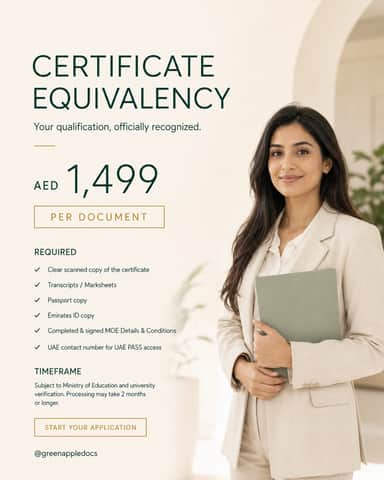
MOE Certificate Equivalency in the UAE: What It Is and Who Needs It
Equivalency is the Ministry of Education confirming that a degree earned abroad carries the same weight as its UAE counterpart. Here is what the file needs, and why it takes longer than people expect.
Legal Translation in the UAE: Who Can Do It and When It Happens
A translation that reads perfectly can still be rejected. For official use in the UAE what matters is who produced it and at what point in the chain it was produced.