Power of Attorney for the UAE When You Are Not in the Country
A power of attorney executed abroad can be used in the UAE, but only if the wording, the language and the chain of stamps all satisfy the authority receiving it. The wording is what fails most often.
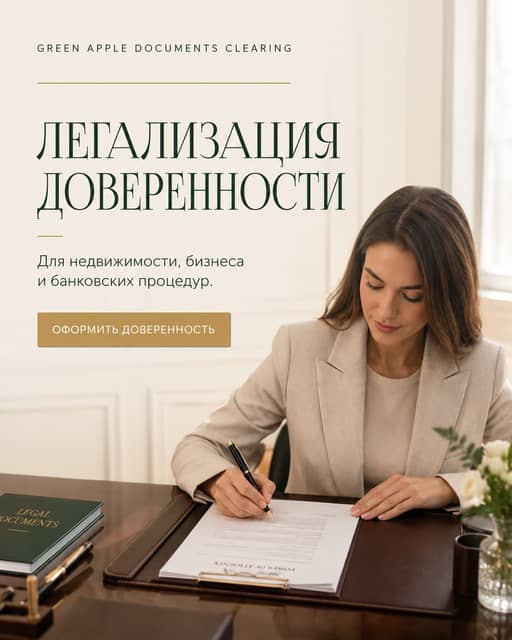
A power of attorney is a short document that fails for long reasons. Someone signs one in London or Moscow so a relative can handle a sale in Dubai, and it is refused — not because it is fraudulent, but because it does not say the right thing in the right way.
The fix is almost always cheaper before signing than after.
Two directions, two routes
Most confusion here comes from not being clear which situation applies.
Executed abroad, used in the UAE. You are outside the country and need someone here to act for you. The document is drawn up and notarised where you are, then authenticated by the local chain, legalised by the UAE embassy or consulate in that country, and attested by MOFAIC once it reaches the UAE.
Executed in the UAE, used abroad. You are here and need to authorise something in another country. The POA is notarised through the UAE notary system, attested by MOFAIC, and then legalised by the destination country's embassy or consulate here.
The order is not interchangeable. Taking a UAE-notarised power straight to a foreign consulate without the MOFAIC stamp means being turned away.
Why the wording decides everything
This is the part that generalist advice skips, and it is the part that fails.
UAE authorities read a power of attorney narrowly. The document has to identify who is granting the authority, who receives it, and precisely what they may do — and if the act is not clearly within the words on the page, the authority will refuse to act on it. Broad language that would be perfectly ordinary elsewhere is treated as insufficient here.
Property is where this bites hardest. A general power of attorney that gives someone authority over "all my affairs" is commonly refused for a property transaction. What is expected is a special power of attorney that names the property and states the act — to sell, to transfer, to mortgage, to register. Land authorities scrutinise these closely, and a document that does not name the transaction will not carry it.
The same principle applies to bank instructions, court representation, company matters and vehicle transfers. Each tends to want the specific act stated.
A general power of attorney still has its place, for broad ongoing administration where no single high-value transaction is contemplated. Choosing between the two is a decision about what will actually be done, and it should be made before drafting rather than after a refusal.
Language
A power of attorney for use in the UAE will generally need to be in Arabic, or bilingual with an Arabic version, and the Arabic is what the receiving authority relies on.
That makes the translation a legal step rather than an administrative one. A translation that renders your intent loosely can narrow or widen the authority you thought you were granting, and the Arabic text is what governs. Translation for this purpose has to be done by a translator licensed for the job — the legal translation guide covers what that means and when in the sequence it happens.
Signing abroad: the practical sequence
Get the wording settled first. Before any appointment is booked, the text should say exactly what the attorney will need to do, in terms a UAE authority will accept. This is the single highest-value step, because everything after it is difficult to change.
Then notarise it where you are, according to local requirements. Some countries want a notary, some a solicitor with specific certification, some require witnesses or a consular officer. The UAE embassy in that country will not legalise a document that was not properly executed under local rules.
Then run the local authentication chain, which in a Hague Convention country usually means an apostille — bearing in mind that the apostille does not replace the UAE embassy step, for the reasons set out in the apostille guide. Then UAE embassy legalisation. Then MOFAIC attestation on arrival.
One alternative is easy to miss: some UAE embassies and consulates can notarise a power of attorney directly for nationals or residents, which can shorten the chain considerably. Whether that is available depends on the mission and the document, and it is a question to ask before committing to the long route.
Things that quietly invalidate a POA
Name mismatches between the passport and the document. Any inconsistency in spelling or order gets treated as a different person.
An expiry the grantor did not notice. Some powers are time-limited by their own wording, and a transaction that slips past the date needs the whole document redone.
Revocation that was never communicated. Cancelling a power of attorney is a formal act, and simply deciding it no longer applies does not end the attorney's apparent authority.
And an attorney who cannot act. The person receiving the authority has to be able to attend, hold the right identification, and in some cases be resident. Naming someone unreachable produces a valid document nobody can use.
Before you sign
Send the draft. Reviewing wording against what the receiving authority will accept takes very little time and is the difference between a document that works and one that has to be executed twice, from another country, with another set of stamps.
If you are arranging a power of attorney from outside the UAE, send us the draft and tell us what it needs to achieve, or read the overview on the power of attorney page.
The services behind this
Full requirements, timelines and document checklists for what this article covers.
- Power of Attorney Attestation A power of attorney is only useful if the receiving authority accepts it. That usually comes down to one choice: general or special. See requirements
- General Power of Attorney A general power of attorney grants broad authority across your affairs — banking, business representation, managing assets — rather than one defined act. See requirements
- Special Power of Attorney A special power of attorney authorises one named act: selling a specific property, representing you in a specific case, transferring a specific vehicle. See requirements
Questions & Answers
Yes. It has to be notarised according to the rules of the country where you sign, then authenticated locally, legalised by the UAE embassy or consulate there, and attested by MOFAIC once it reaches the UAE.
For a specific transaction, particularly anything involving property, a special power naming the property and the act is generally required. General powers are routinely refused for property transactions. A general power suits broad ongoing administration where no single major transaction is planned.
For use before UAE authorities it will generally need an Arabic version, and the Arabic text is what the authority relies on. That makes the translation a substantive step — a loose rendering can change the scope of authority you intended to grant.
Some UAE missions can notarise a power of attorney for nationals or residents, which shortens the chain considerably. Availability depends on the mission and the document, so it is worth asking before committing to the full route.
Revocation is a formal act and has to be executed and communicated properly. Simply deciding it no longer applies does not remove the attorney's apparent authority, so speak to us before relying on an informal cancellation.
Keep reading

Apostille vs Attestation for the UAE: Why an Apostille Alone Is Never Enough
An apostille is a single certificate that replaces a chain of embassy stamps between member countries. The UAE is not one of those countries, and assuming otherwise is the most expensive mistake in this whole process.
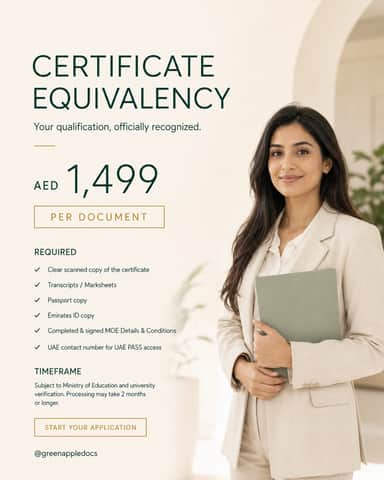
MOE Certificate Equivalency in the UAE: What It Is and Who Needs It
Equivalency is the Ministry of Education confirming that a degree earned abroad carries the same weight as its UAE counterpart. Here is what the file needs, and why it takes longer than people expect.